Lyon is a vibrant city in France known for its rich history, stunning architecture, and culinary scene.
Lyon, France, is renowned as one of the world’s culinary capitals, and it’s a fantastic place for anyone looking to study and develop their skills in the culinary arts. The city is home to many Michelin-starred chefs.
One of the best-known culinary schools in Lyon is the Institute Paul Bocuse, named after the legendary French chef. The institute is world-class, offering courses in various culinary disciplines. Students there receive both theoretical knowledge and practical training.
Through its immersive approach, Lyon not only teaches culinary techniques but also teaches for food culture, creativity, and innovation.
If you want to learn something in your holiday, you should learn culinary in Lyon, in the Institut Paul Bocuse, which offers professional training and short courses in French cuisine.
Navigate Upper-Intermediate Writing / An email of complaint/ slide 24/ Watch the video Learning Holidays ex -es 3,4 slide 25
3. Watch the video. Read the summary and choose the correct options to complete it.
St Ives is a seaside town in the south west of Britain. As well as being famous for its sandy beaches, it is well known for its arts scene. By the 1950s, it had become home for a large group of influential artists. In the video, the presenter attends a course at the St Ives School of Painting. The school, which opened in 1938, runs courses in a range of art forms. It is located on the edge of a beach. The maximum number of students in a class is eight. The presenter attended a two-day course for beginners, for which the school provided all of the materials. At the end of her learning holiday, she bought herself a paintbrush as a souvenir.
4. Watch again. What does the presenter say about…?
a. the features of St Ives St Ives is Britain’s one of the most famous seaside towns. It has one of the most stunning scenery in the country. It’s famous for its beaches and arts. b. her previous experience of painting She hadn’t picked up a brush since she left school, but she came here to change that. c. the arts scene in St Ives For a long time the town attracted many talanted artists. The St Ives painting school is a major part of the towns thriving art scene. Many of the teachers there a prominent artists. d. the school’s philosophy The school provides everything, all you have to do is turn up with an open mind and lots of enthuziasm. e. her plans to do another painting course She wants to practice and be confident in painting.
In 1915, during the Armenian Genocide, six Armenian villages in the Musa Ler region resisted Ottoman deportation orders. For 53 days, the villagers held off Turkish forces on the mountain with using anything they found as weapons, they also rationed their supplies very well. Until French warships rescued them. Over 4,000 Armenians escaped Ottomans and were evacuated to Egypt.
Navigate Upper-Intermediate Watch the video and do the ex-es 1,3,4 slide 15 Navigate Upper -Intermediate Review 1a,b, 2a , 3 slide 16
1. Match the sentence halves.
An official language is a language — c. with special legal status, used by the government, etc.
An indigenous language is a language — e. native to a country or region.
A dominant language is the language — a. that most people in a country speak.
A minorty language is an official language that is spoken — b. by just a small number of people in a country or region.
A global language is spoken — d. all around the world.
3. Watch the video. Are sentences 1-5 true(T) or false(F)?
92% of people in the UK speak english at their first language. T
In Scotland, Scottish Gaelic is spoken by around 60,000 people. T
In Ireland, only a few people understand Irish. F
In Wales, Welsh is spoken by about 50% of the population. F
In Cornwall, hardly anybody speaks Cornish. T
4. Watch again. Choose the correct options to complete the sentences, according to the video.
Welsh, Scottish Gaelic, Irish and Cornish have their roots in Celtic culture.
There are Scottish Gaelic communities in northern Canada.
The first official language of the Republic or Ireland is Irish.
Welsh is most spoken in the north of Wales.
Cornish is spoken by a few hundred people.
Experts predict that 50% of the world’s languages will die out by the end of the century.
1a. Write questions about the underlined pronouns.
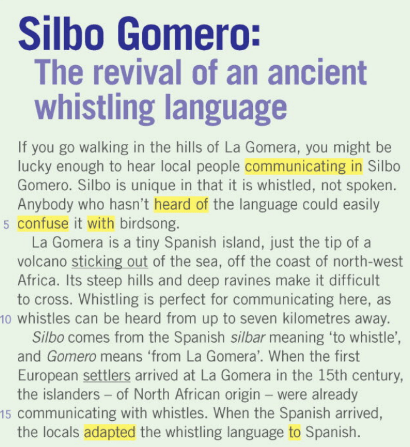
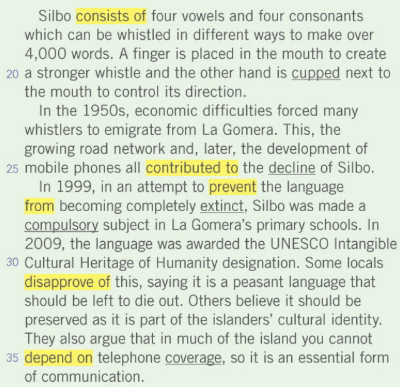
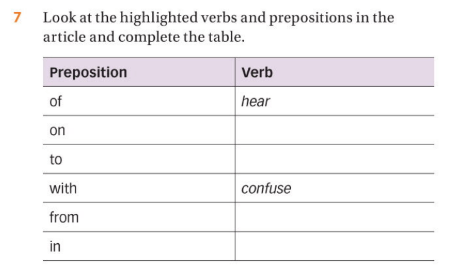
1. A. It arrived this morning. B. What arrived this morning? A. Your postcard. 2. A. She collects old typewriters. B. Who collects old typewriters? A. My cousin. 3. A. I texted him by mistake. B. Who did you text by mistake? A. Mattias. 4. A. He often confuses me with my twin brother. B. Who often confuses you with your twin brother? A. My football coach. 5. A. I had never heard of it before. B. What had you never heard of before? A. Silbo Gomero.
b. Complete each question by adding the missing word.
How many friends can you rely on?
Do you think you will go abroad this summer?
What are you learning English for?
Is there anything you strongly disapprove of?
2. Complete the paragraph with the present perfect simple or continuous.
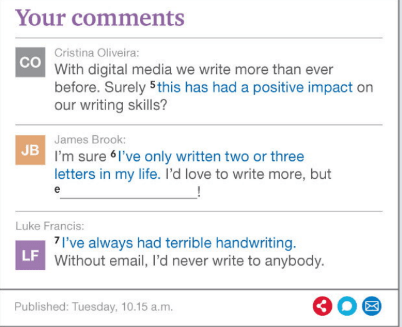
I’m going on a big trip to Argentina soon, so for the last few weeks I’ve been trying to brush up my Spanish. I’ve studied Spanish before, but I’ve forgotten quite a lot, so I’ve been going to evening classes. They’ve been very helpful. I’ve downloaded a Spanish vocabulary app for extra practice and I’ve also been reading a book in Spanish. It’s a slow process, but I’ve nearly finished it.
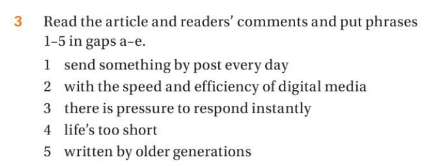
1. with the speed and efficiency of digital media 2. there is pressure to respond instantly 3. written by older generations 4. send something by post every day 5. life’s too short
1. When we handwrite, we write more thoughtfully, recieving it is a plessure and if we stop, it will be a loss for culture.
2. Newspapers report a rise in stationary sales.
3. Electronic letters are fast and we write more of them.
Even though electronic letter are faster, I agree with the text, that handwritten ones are more beautiful and thoughtful.
My mood for the start of the new academic year is nervous but also motivated because this is like a new chapter that I’m starting. I’ve made a promise to myself to study harder this year, as I know it’s important for my future. I want to improve and make changes to some of my habits, especially procrastination, so I can achieve as much as I can. Even though I know it will be tougher than before, I’m ready to face the challenges ahead. There will be a lot of work to do, including research projects, while also attending different lessons and preparing for exams next year. It definitely won’t be easy, but I see it as a chance to learn how to discipline myself better and manage my time more efficiently. I hope to work more effectively this year, staying on top of things instead of letting them pile up and falling behind. Even though I’m a bit nervous about how much effort this will all take, I’m still motivated by the idea of making progress and improving. I know it won’t always go smoothly, but I’ll deal with things as they come and adjust along the way.






 Նանե Խաչատրյան