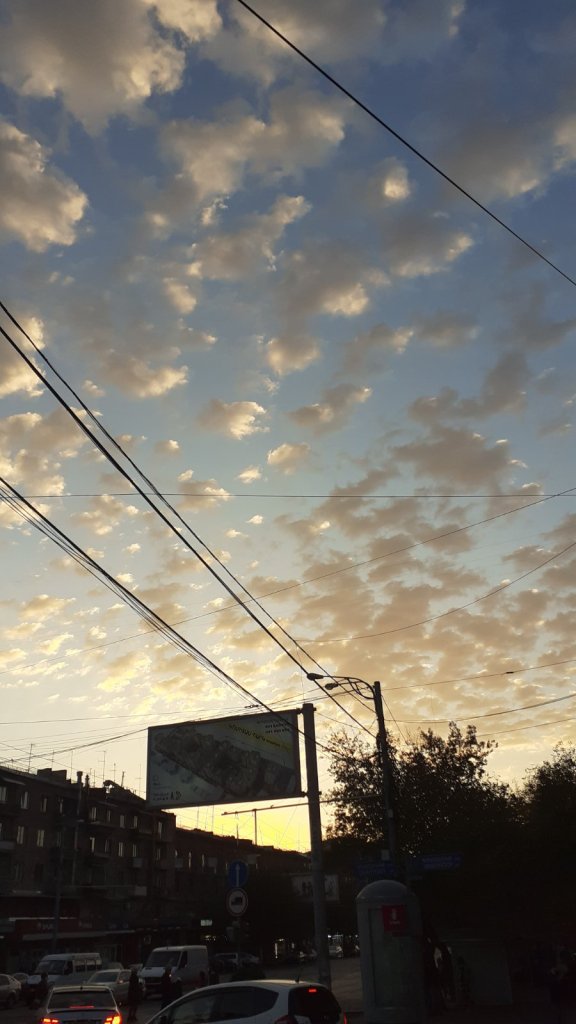
Each season has its wonders and charm, but many of us think that autumn is special, because autumn surprises us with its richness: juicy fragrant fruits and vegetables, colorful leaves… Look out of your window, describe autumn in your yard, in your street.
Autumn is a very beautiful season. In our yard trees already are yellow and orange. It’s very beautiful. Leaves are falling. Days are shorter and it’s a bit cold. It’s often raining and that atmosphere is very relaxing. It’s quiet in yard and no one is playing. Clouds are very beautiful and sun is bright.
In it there were 67 Melibines. Melibines are aliens, but they are like human. They have hands, legs, body, head, in short, they have everything people have, but Melibines are very small. They have special power: they can transform into everything they see. So they arrive to Earth after 6 hours. When they arrive they were standing in the yard of some school in Amsterdam. Kids noticed Melibines and stood around to see who they were. One little pupil wanted to take them, but all Melibines started to shout very loudly, all students ran away. They started their journey, but for it they transformed into human they saw before. Melibines work was to find a good place to live. For many hours they where searching a good place, to live there with some of Melibines, but don’t find anything good for them. Suddenly they saw a woman with a big bag what was opened and they transformed to their normal look and very fast they jumped into it. Melibines haven’t got anything else to do so they decided to see what are people doing and so they can find some good place for living. That woman closed the bag and there was very dark in it. They wanted to sleep, because all their energy they spend to find place. All the time bag was rumpling, but they were sleeping and don’t felt it. Suddenly it hit the ground, they were scared and jumped. Melibines don’t understand anything at first they woke up. They opened a little part of zipper on the bag and saw a little room where there was walking that woman. She jumped on the bed and fall asleep. Melibines get out from the bag and go to a door with glass so they saw that outside there there were a lot of trees and blue sky with bright sun. They decided to go outside, because there wasn’t any other exit. But outside it was balcony and it was very high. But they had a plan: at first they transformed into people, secondly one of them had to be caught in the bars and they were holding each other one by one to come down. Melibines quickly go away from there and come to a jungle, that was very far from hotel. In jungle they so animals like insects, snakes, but then they saw monkey. Monkeys noticed them and began to attack, but Melibines quickly transformed to them and started to attack them too. Monkeys ran away. Melibines thought that that jungle will be very good home for them and decided to force to go all the people of that island. And they did it. All people were evacuated from island and now it was free. Melibines called their leader and he liked that island. Now part of Melibines are living on that island and now it is called Meliland.
The wheel is one of the most famous inventions. This technology not only made it easier to travel, but also served as the base for other technologies. But the wheel is not very old. The oldest known wheel is from Mesopotamia and was created around 3500 BC. Inventors were the Sumerian people, who inserted rotating axles into discs of wood. It was only in 2000 BC that the discs began to be hollowed out to make a lighter wheel. By that time, humans were already casting metal alloys, constructing canals and sailboats, and even designing complex musical instruments.
In fact, the main invention was not the wheel itself, which was likely invented the first time someone saw a rock rolling along, but the combination of a wheel and a fixed axle, which allows the wheel to be connected to a stable platform. Without the fixed axel, the wheel has only very limited utility.
Respect, trust, education, early, late, have difficulty, mother, study, opinion
I don’t know about who I will write letter. I love all my teachers, but I will write about my Georgian teacher.
«Hello or Gamarjoba
Happy to write you, Mrs. Rina. I want to say you, that you are one of my favorite teachers. I love you because you are very kind and funny. You always tell us very funny stories of your job or all your life. Your lessons are very interesting and you study very well. We all can trust you. You are friendly to students and don’t shout at them, you try to understand them and it is very important quality.
Choose the correct or most appropriate future forms to complete the sentences below. You have completed this test. Correct answers: 8/10. Your score is 80%.
Check your answers:
1. He looks very pale and confused. He is going to faint . ➪ We use be going to to talk about something that is very near to happen or that we see is going to happen (there is present evidence)
2. Somebody is at the door. I ‘m going to check who it is.
Correct answer: ‘ll check ➪ We use will for decisions that we take at the moment of speaking (instant decisions).
3. ‘I’ll never pass the exam.’ ‘Don’t worry, I will help you prepare it.’ ➪ We use will for promises or instant decisions.
4. I ‘ll meet John’s parents for the first time tomorrow.
Correct answer: ‘ll be meeting ➪ We can use present continuous or future continuous to talk about future arrangements.
5. We ‘re leaving at 9 tomorrow, because the train leaves at 9.45. ➪ We often use the present continuous to talk about future arrangements. ➪ We use the present simple to talk about future events that are scheduled or timetabled.
6. By the end of the month I ‘ll have been working here for 25 years. ➪ We use the future perfect continuous with dynamic verbs to talk about the duration of a situation until a certain time in the future.
7. What are you going to do next weekend? ➪ We use be going to to talk about future intentions or plans.
8. Will you take Jack to school today, please? ➪ We use will in requests, i.e. when we are asking someone to do something.
9. I ‘ll never trust you again. ➪ We use will in promises and refusals.
10. I love photography. I ‘m going to buy a digital camera soon. I just need to save a bit more. ➪ We use be going to to talk about future intentions or plans.
Exercise 2
Choose the correct or most appropriate future forms to complete the sentences below. You have completed this test. Correct answers: 10/10. Your score is 100%.
Check your answers:
1. We need to be there at ten, and if you don’t go faster we won’t have arrived by then. ➪ We use the future perfect simple for actions that will be completed before certain time in the future.
2. Please, don’t make noise when you arrive, because I ‘ll be putting the baby to bed. ➪ We use the future continuous for situations or actions that will be in progress at a certain time in the future.
3. Our plane leaves next Tuesday morning. We are flying first to Toronto and then to New York. ➪ We use the present simple to talk about future events that are scheduled or timetabled. ➪ We can use present continuous to talk about future arrangements.
4. I don’t think he will find a job easily. ➪ We use will to talk about something we think that will happen.
5. In 2100, humans won’t be living in this planet any more. ➪ We use the future continuous for situations or actions that will be in progress at a certain time in the future.
6. When they arrive next week, they will have been travelling for 3 entire months and they will have visited 8 different countries. ➪ We use the future perfect continuous with dynamic verbs to talk about the duration of a situation until a certain time in the future. ➪ We use the future perfect simple for actions that will be completed before certain time in the future.
7. If you ever need me, I will be there for you. ➪ We use will for promises.
8. Are you going to finish that chocolate cake? ➪ We use be going to to talk about future intentions or plans.
9. Please, promise you won’t say anything about the accident. ➪ We use will for promises.
10. You dropped your wallet. I ‘ll pick it up for you. ➪ We use will for decisions that we take at the moment of speaking (instant decisions).
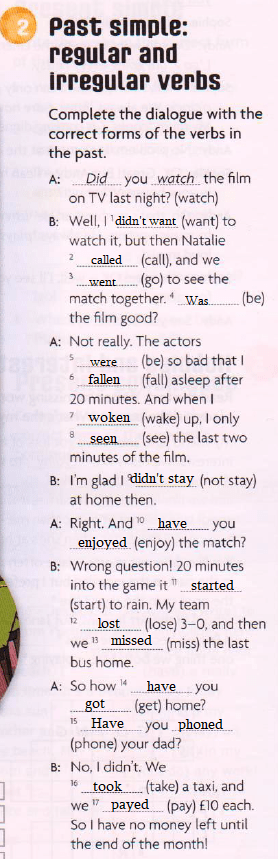
1) She has never (let) her daughter have a boyfriend. She has never let her daughter have a boyfriend.
2) Have you already (read) today’s newspaper?[ . ] Have you already read today’s newspaper?
3) The house has been (sell).[ . ] The house has been sold.
4) He has (lose) his wallet again.[ . ] He has lost his wallet again.
5) I have (write) three essays this week.[ . ] I have written three essays this week.
6) That clock was (make) in Switzerland.[ . ] That clock was made in Switzerland.
7) He had (run) 6 miles when he hurt his ankle.[ . ] He had run 6 miles when he hurt his ankle.
8) I have never (see) such a beautiful view.[ . ] I have never seen such a beautiful view.
9) He has (teach) hundreds of students during his career.[ . ] He has taught hundreds of students during his career.
10) Have you ever (meet) a famous person?[ . ] Have you ever met a famous person?
11) Because she hadn’t (pay) the bill, the electricity went off.[ . ] Because she hadn’t paid the bill, the electricity went off.
12) They have (send) Christmas cards to all their friends.[ . ] They have sent Christmas cards to all their friends.
13) Where have we (put) the car keys?[ . ] Where have we put the car keys?
14) We have never (sing) in public before.[ . ] We have never sung in public before.
15) She had (wear) her blue dress many times.[ . ] She had worn her blue dress many times.
16) John had never (speak) English before he came to London.[ . ] John had never spoken English before he came to London.
17) Why have you (stand) up – are we leaving?[ . ] Why have you stood up — are we leaving?
18) Have you ever (swim) in the Atlantic Ocean?[ . ] Have you ever swum in the Atlantic Ocean?
19) It had (take) three hours to reach the station, so they had missed the train. It had taken three hours to reach the station, so they had missed the train.
20) I have never (say) that I didn’t love you. I have never said that I didn’t love you.
21) David jumped into the air. He had (sit) on a drawing pin. David jumped into the air. He had (sit) on a drawing pin.
22) The weatherman had (tell) us it would be sunny, but it rained all day. The weatherman had told us it would be sunny, but it rained all day.
23) I’m sorry I’m so tired. I haven’t (sleep) . I’m sorry I’m so tired. I haven’t slept.
24) Have you (think) about changing jobs? Have you thought about changing jobs?
25) He’d thought he had (understand) but now he realised he’d made a mistake. He’d thought he had understood the problem, but now he realised he had made a mistake.





 .
. who it is.

 Նանե Խաչատրյան